SEO explained without jargon: how Google picks which pages to show, the three parts of SEO, and the steps a business owner can follow to get found.
You have a website, but customers are not finding it. Competitors with weaker products show up on Google, and you do not. If that sounds familiar, the missing piece is usually SEO, short for search engine optimization.
So what is SEO? It is the work of making your website easy for search engines to understand and worth showing to the people searching. Done well, it brings a steady flow of visitors who are already looking for what you sell, without paying for every click.
This guide explains SEO in plain English, for business owners in the USA, UK, Canada and Europe who want to know what it is, how it works and what to do first.
What SEO actually means
When someone types a question into Google or Bing, the search engine has to choose a handful of pages out of millions. It wants to show the most useful, trustworthy answer for that exact search.
SEO is everything you do to help your pages be that answer. It is not a trick and it is not a one-time setting. It is a mix of good content, a technically sound website and a reputation that other sites recognize.
The free listings Google shows are called organic results. The ones marked "Sponsored" are paid ads. SEO is about the organic results. You cannot pay Google to rank higher there, which is exactly why people trust them.
How search engines work, in three steps
Search engines follow roughly the same pattern:
- Crawling. Automated programs (crawlers or bots) follow links around the web and discover your pages.
- Indexing. The search engine reads each page, works out what it is about and stores it in a huge database called the index.
- Ranking. When someone searches, the engine pulls matching pages from the index and orders them by how relevant and useful they seem.
If a page is not crawled, it cannot be indexed. If it is not indexed, it cannot rank. Many SEO problems are as simple as Google never finding or understanding a page. Our technical SEO checklist covers how to check this.
The three pillars of SEO
Most SEO work fits into three groups.
On-page SEO
This is about the content on each page. Does the page answer the search clearly? Does the title say what the page is about? Are headings, images and text written for people first?
A good starting point is keyword research, which tells you the words your customers actually use. You then build one focused page for each group of related searches.
Technical SEO
This is about the website itself. Can search engines crawl it? Does it load quickly on a phone? Is it secure (HTTPS)? Are there broken links, duplicate pages or redirect chains?
Technical problems are invisible to most visitors but can quietly hold a whole site back. They often come from the way a site was built, which is why the platform choice matters. We compare the options in WordPress vs a custom website.
Off-page SEO
This is about your reputation across the web. When other trusted websites link to you, mention your business or review you, search engines take it as a sign that you are worth showing.
For businesses that serve a city or region, off-page work also includes your Google Business Profile, directory listings and reviews. Our local SEO guide explains this in detail for each country.

Why SEO matters for a business
Paid ads stop the moment you stop paying. SEO works more like an asset. A useful page you publish this year can keep bringing visitors for years, as long as it stays accurate and the site stays healthy.
SEO also reaches people at the right moment. Someone searching "accountant for small business in Leeds" or "custom CRM developer Toronto" has a need right now. Being in front of them then is worth far more than a banner they scroll past.
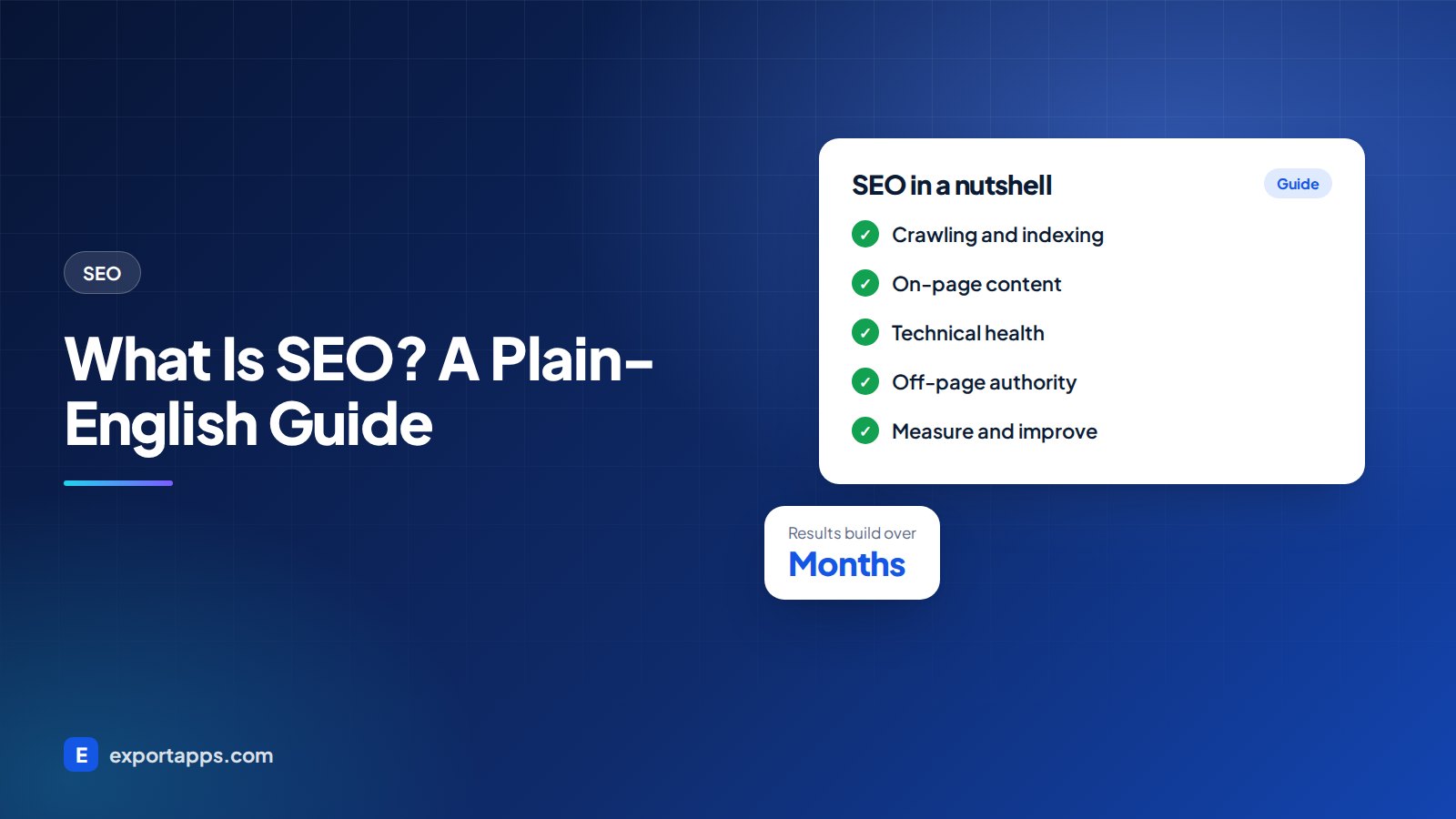
That said, SEO is not instant and it is not guaranteed. Nobody controls Google, and any agency that promises a number one ranking is a red flag. Results build over months. We explain realistic timelines in how long does SEO take.
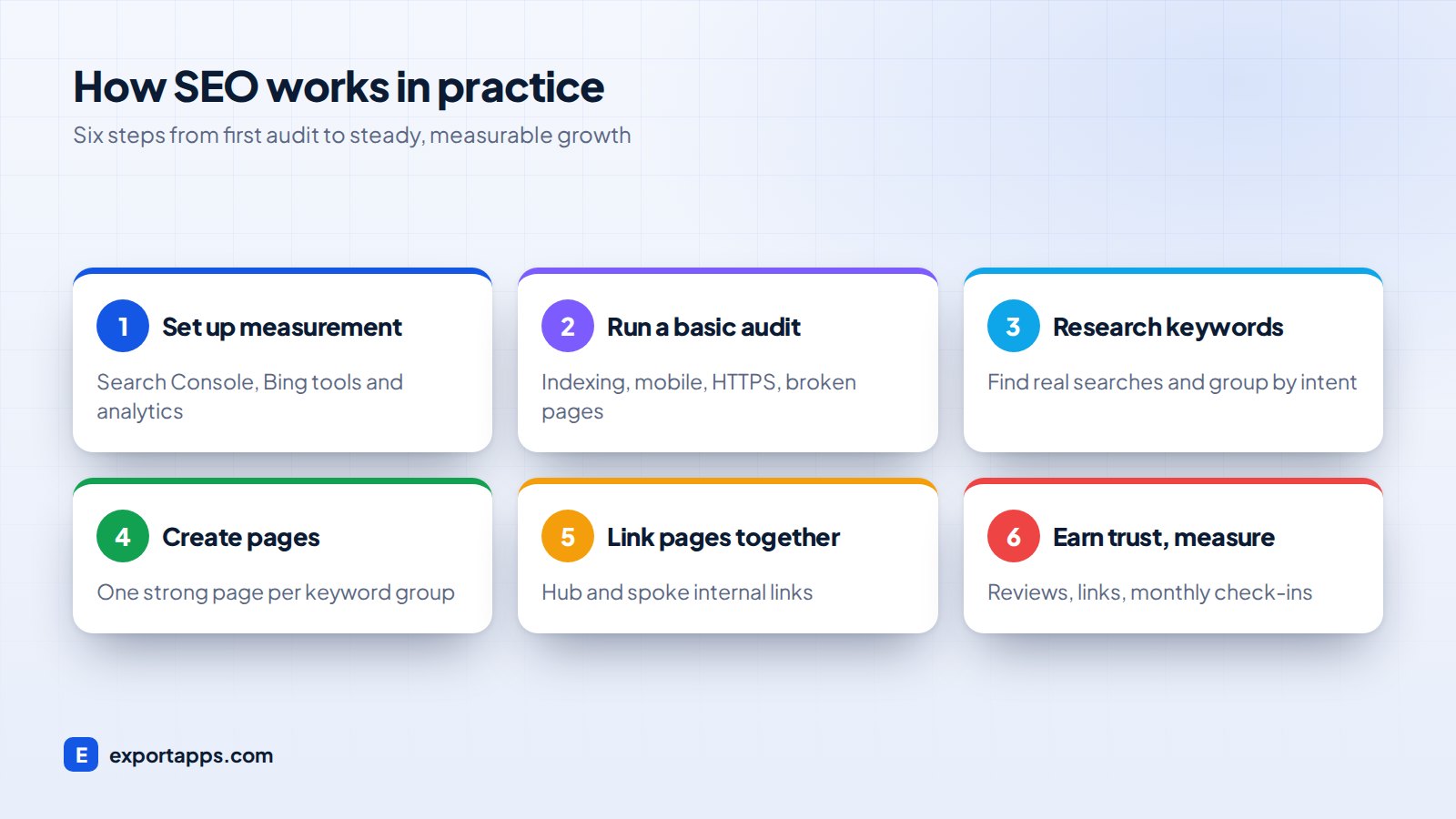
How SEO works in practice: a simple process
Here is the process we follow with clients, and the one you can follow yourself on a small site.
1. Set up measurement
Connect your site to Google Search Console and Bing Webmaster Tools (both free) and an analytics tool. Search Console shows which searches you already appear for and any indexing problems Google has found.
2. Run a basic audit
Check that your important pages are indexed, that the site works well on mobile, that it uses HTTPS and that there are no obvious broken pages. Fix the biggest problems first.
3. Research keywords
List the services you sell and the questions customers ask. Turn these into search phrases and group them by intent. Each group becomes one page.
4. Create or improve pages
Write one strong page per keyword group. Make the title, first paragraph and headings clear. Answer the question better and more honestly than the pages already ranking.
5. Connect pages with internal links
Link related pages to each other so visitors and search engines can follow the topic. A simple hub and spoke structure works well; see our internal linking guide.
6. Earn trust and measure
Ask happy customers for reviews, get listed in relevant directories, and share genuinely useful content that others want to link to. Every month, check Search Console, see what improved, and repeat.
What SEO is not
A few myths are worth clearing up:
- SEO is not keyword stuffing. Repeating a phrase dozens of times makes a page worse for readers and search engines.
- SEO is not buying links. Paid link schemes break Google's guidelines and can lead to penalties.
- SEO is not a one-off project. Competitors keep publishing, and search engines keep updating. A little steady work beats one big push.
- SEO is not just for big companies. A small business with a focused, well-built site can outrank larger competitors for specific local or niche searches.
Can you do SEO yourself?
Yes, especially the basics. Many owners handle their Google Business Profile, ask for reviews and write helpful service pages themselves.
Where outside help usually pays off is technical work, site structure and a consistent content plan. If you are weighing it up, our guide to SEO services cost lists typical price ranges in the USA, UK, Canada and Europe, so you know what is reasonable.
If your site is being rebuilt, bring SEO in from the start. A redesign can wipe out years of rankings if URLs change without redirects. Our website redesign checklist shows how to avoid that.
Frequently asked questions
What is SEO in simple terms?
SEO (search engine optimization) is the work of making your website easy for search engines to understand and useful enough that they show it to people searching for what you offer, in the free results.
Is SEO better than paid ads?
They do different jobs. Ads bring traffic immediately but stop when you stop paying. SEO takes longer to build but can keep bringing visitors without a cost per click. Many businesses use both.
How much does SEO cost?
It ranges from doing it yourself for free to monthly retainers with an agency. Typical ranges are covered in our SEO pricing guide. Your project may differ depending on competition and site size.
Can anyone guarantee first place on Google?
No. Search engines decide rankings, and they change their systems often. A trustworthy SEO partner promises a clear process and honest reporting, not a fixed position.
Getting started
SEO rewards businesses that are clear about what they do, build a solid website and keep publishing useful content. Start with Search Console, fix the obvious problems and build one great page for each service you sell.
If you would like help, our SEO and growth team can audit your site and build a plan that fits your market. Book a free consultation and we will give you a clear, fixed quote.