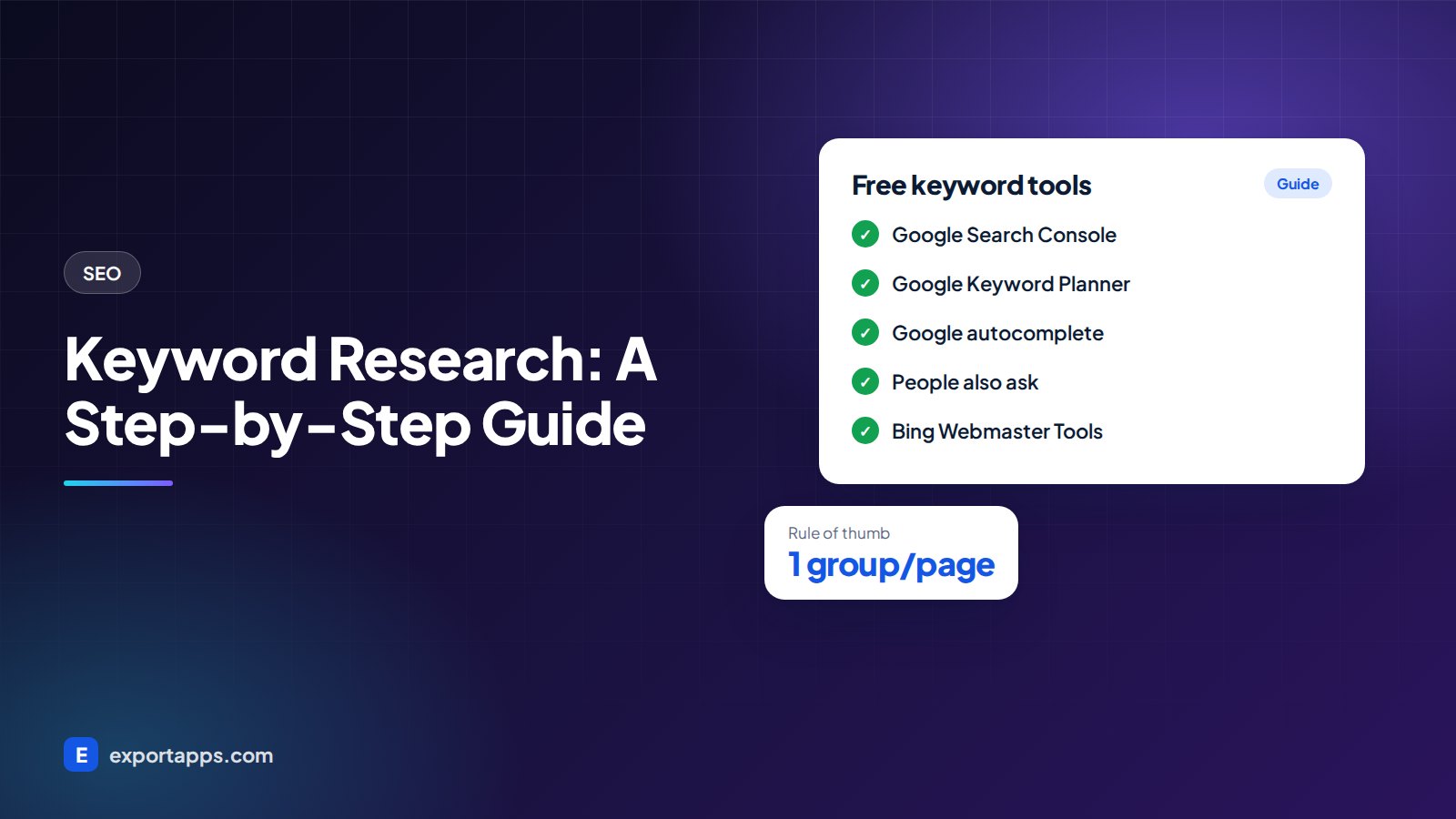
Find the words your customers actually search for, using free tools, then map one keyword group to each page. A practical, step-by-step method.
Most business websites describe their services in their own words. Customers search in theirs. A firm might call itself a "digital transformation partner" while its buyers type "custom software company near me". Keyword research closes that gap.
This keyword research guide walks you through a simple, repeatable method: start with seed keywords, understand search intent, find long tail phrases with free tools and map one keyword group to each page of your site.
What keyword research is, and why it matters
A keyword is any word or phrase people type (or say) into a search engine. Keyword research is the process of finding the phrases your potential customers use, understanding what they want when they use them and deciding which page on your site should answer each one.
It matters because it shapes everything else in SEO: which pages you build, what you call them, how you write them and how you link them. Good research stops you writing pages nobody searches for, and stops you building five pages that compete for the same search.
Four ideas to understand first
Seed keywords
Seed keywords are the short, obvious phrases that describe what you do: "web design", "accountant", "mobile app development". They are the starting point, not the finish line. On their own they are usually too broad and too competitive.
Search intent
Search intent is the reason behind a search. Google tries hard to match it, so you should too. There are four broad types:
- Informational: the person wants to learn ("what is a CRM").
- Commercial: they are comparing options ("best CRM for small business", "Flutter vs React Native").
- Transactional: they are ready to act ("hire app developers", "CRM development quote").
- Navigational: they want a specific site ("Export Apps contact").
The easiest way to check intent is to search the phrase yourself and look at what ranks. If the top results are all guides, a sales page will struggle. If they are all service pages, a blog post will struggle.
Long tail keywords
Long tail keywords are longer, more specific phrases, such as "custom CRM for a cleaning company" or "how much does a website cost in the UK". Each one has fewer searches than a seed keyword, but together they make up a large share of all searches. They are usually easier to rank for and often closer to a buying decision.
Keyword groups
Many phrases mean the same thing: "website cost", "how much is a website", "website design prices". Google usually shows similar results for all of them. Treat them as one keyword group that one page should target, rather than separate pages.

The keyword research process, step by step
1. List your seed keywords
Write down every product and service you sell, the problems you solve and the types of customer you serve. Add your locations if you serve specific areas. Ask your sales or support team which words customers use on calls and in emails. Aim for 10 to 30 seeds.
2. Check what you already rank for in Google Search Console
If your site is live, Google Search Console is the best free source you have. Open the Performance report and look at the Queries tab. It shows the real searches where your site appeared, with clicks, impressions and average position.
Look for queries with many impressions but low clicks or an average position between roughly 8 and 20. These are opportunities: Google already links you to the topic, and a better page could move you up. Bing Webmaster Tools offers similar data for Bing.
3. Expand with Google autocomplete
Type each seed keyword into Google slowly and note the suggestions that appear. Then try adding letters ("web design a", "web design b") or question words ("how", "why", "cost", "best"). Autocomplete is based on real searches, so it is an easy way to find long tail phrases.
4. Mine "People also ask" and related searches
On the results page, open the People also ask box. Each question you click reveals more. Note them all, along with the related searches at the bottom of the page. These questions make great sections and FAQ answers on your pages.
5. Get rough volumes from Google Keyword Planner
Google Keyword Planner sits inside Google Ads. You can use it without running ads, though without active spend it often shows wide volume ranges rather than exact numbers. That is fine: you only need to know whether a phrase is searched a lot, a little or barely at all. You can set the location to the USA, UK, Canada or a European country, which is useful because phrasing differs ("attorney" vs "solicitor", "cell phone" vs "mobile").
Paid tools such as Ahrefs, Semrush or Moz add competitor data and difficulty scores, but the free tools above are enough for most small businesses to start.
6. Group keywords by intent and topic
Put all your phrases in a spreadsheet. Add columns for intent, rough volume and topic. Then group phrases that mean the same thing and share the same intent. A quick test: if the same pages rank for two phrases, they probably belong in one group.
7. Map one keyword group to one page
Now assign each group to exactly one page, either an existing page or a new one you will create. This is your keyword map.
- Service and transactional groups go to service pages.
- Commercial and informational groups go to guides, comparisons and blog posts.
- Location groups go to genuine location pages, as explained in our local SEO guide.
One group per page stops your pages competing with each other (often called keyword cannibalization) and gives each page a clear job.
8. Prioritize and plan content
You will have more groups than time. Score each one on three things: business value (would this searcher become a customer?), how realistic it is to rank, and effort. Start with high-value, realistic groups, often long tail commercial and transactional phrases.
Then link related pages together into topic clusters, with a main hub page and supporting articles. Our guide to internal linking for SEO shows how.

Using keywords on the page
Once a page has its keyword group:
- Use the main phrase in the title tag and the H1, naturally.
- Mention it, or a close variation, in the first 100 words.
- Use related phrases and questions as subheadings.
- Answer the searcher's question fully and honestly.
- Write for people. Repeating the phrase over and over does not help and reads badly.
The structure of your site matters too. If you are planning a new site, bring the keyword map into the planning stage of the website design process so pages and URLs are built around real searches. When redesigning, keep the map and URLs in mind; our website redesign checklist explains why.
Common keyword research mistakes
- Only chasing high volume. Broad phrases bring mixed visitors and fierce competition.
- Ignoring intent. A sales page will not rank for a "how to" search.
- One page per tiny variation. This splits your authority and confuses Google.
- Forgetting local spelling and terms. US, UK and Canadian searchers often use different words.
- Doing it once. Revisit your Search Console data every few months.
Frequently asked questions
What are the best free keyword research tools?
Google Search Console (your real search data), Google Keyword Planner (rough volumes), Google autocomplete and the People also ask box. Bing Webmaster Tools is also free and useful.
How many keywords should a page target?
One main keyword group. A group can include many close variations and related questions, but they should all share the same intent.
Should I target high volume keywords?
Only if they are relevant and realistic. For most small businesses, specific long tail phrases with clear buying intent bring better leads sooner.
How often should I do keyword research?
Do a full round when planning a site or a content plan, then review Search Console every few months to spot new queries and pages that are close to page one.
Turn keywords into customers
Keyword research is not about finding magic words. It is about understanding what your customers want and giving each need one clear, useful page. Done well, it makes every other part of SEO easier.
If you would like a keyword map built for your business, our SEO and growth services include research, mapping and content planning. Book a free consultation and we will give you a clear, fixed quote.