Every agency portfolio looks great. Use these 7 steps, 12 questions and red flags to choose a web design company you can trust.
Your website is often the first thing a customer sees before they call you, visit you or buy from you. So when it is time to hire someone to build it, the stakes feel high. Every agency's portfolio looks polished, every proposal promises "results", and it is hard to tell who will actually deliver.
This guide shows you how to choose a web design company step by step: what to look for, which questions to ask, how to compare proposals, and the warning signs that should make you walk away. It works whether you are in the USA, UK, Canada or Europe, and whether your budget is small or large.
What a good web design company actually does
A website is more than a nice design. A good partner should help you with:
- Strategy: who the site is for and what you want visitors to do.
- Structure and content: a clear sitemap, page layouts and words that answer customer questions.
- Design: a look that fits your brand and works on every screen size.
- Development: a fast, secure, accessible site your team can update.
- SEO foundations: clean URLs, page titles, speed, mobile friendliness and structured data, so search engines can understand your pages. If you are new to this, read what SEO is and why it matters.
- Launch and support: testing, going live safely and looking after the site afterwards.
Some companies are strong at design but weak at development, or the other way round. Your job is to find one that covers the parts that matter for your goals.
How to choose a web design company: 7 steps
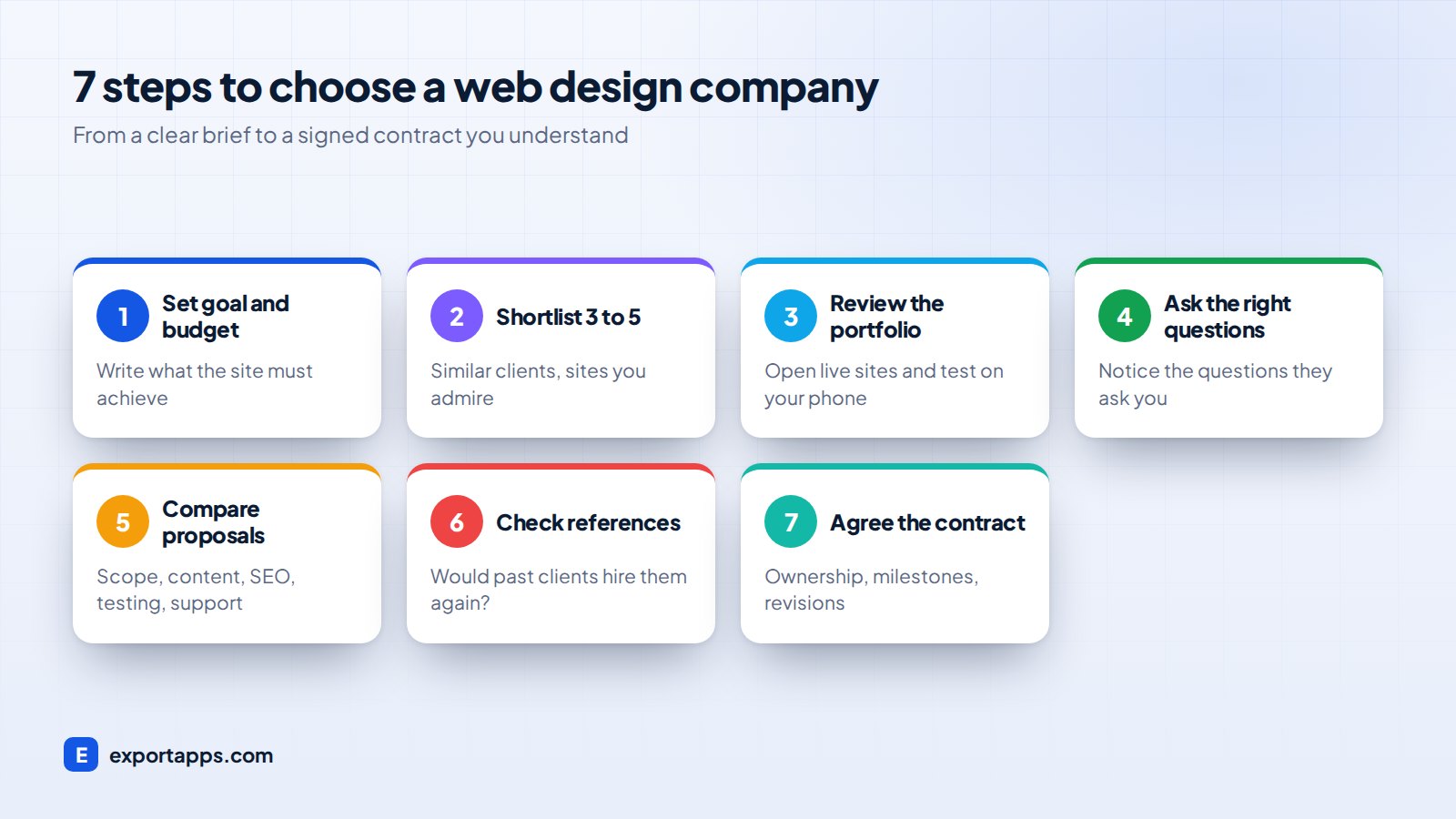
1. Define your goal and budget first
Before you contact anyone, write down what the website must achieve and a realistic budget range. "Get more quote requests from homeowners in Manchester" is a far better brief than "a modern website." If you are not sure about budget, our guide to website design cost in 2026 gives typical ranges by type of site.
2. Make a shortlist of 3 to 5 companies
Look for companies that have built sites for businesses similar in size or industry to yours. Good sources are recommendations from people you trust, sites you admire (check the footer credit) and review platforms. Three to five candidates is enough to compare without wasting weeks.
3. Review their portfolio properly
Do not just look at screenshots. Open the live sites they built and check:
- Do they load quickly on your phone?
- Is the text easy to read and the navigation obvious?
- Do the sites look different from each other, or is every client given the same template?
- Are the sites still live and maintained?
4. Ask the right questions on the first call
Use the questions in the next section. Pay attention to the questions they ask you. A company that asks about your customers, competitors and sales process is thinking about results, not just pixels.
5. Compare written proposals side by side
Ask each company for a written proposal with a fixed price, a scope list, a timeline and what happens after launch. Then compare them line by line, not just on the total.
6. Check references
Ask for one or two past clients you can speak to. A short call will tell you more than any case study: did they hit deadlines, were they easy to work with, and would the client hire them again?
7. Agree the contract details before you sign
Confirm ownership, payment milestones, number of revisions, support terms and how changes are priced. Then sign.
12 questions to ask a web design company
- Have you built websites for businesses like mine?
- Who will actually work on my project, and can I meet them?
- What is your design and build process? (Compare it with our 7-step website design process.)
- Which platform do you recommend for me, and why? See WordPress vs custom website for the trade-offs.
- Is the price fixed, and what exactly is included?
- How many rounds of design revisions are included?
- Who writes the content and supplies the images?
- How do you handle SEO during the build, and for redesigns, how will you protect our current rankings?
- How do you make the site fast and accessible?
- Who owns the domain, hosting account, design files and code when the project ends?
- What does support cost after launch, and what is your response time for urgent problems?
- How do you handle privacy rules such as GDPR, UK GDPR, CCPA or PIPEDA for forms and cookies?
The answers do not need to be perfect, but they should be clear, specific and in writing.
How to compare proposals fairly
Proposals often look very different, which makes comparing them hard. Put them on the same footing by checking each one for:
- Scope: number of pages and unique page templates, features and integrations.
- Content: whether copywriting, photos and moving content from your old site are included.
- SEO setup: titles, meta descriptions, redirects, sitemap, analytics and basic schema.
- Testing: browsers, devices and speed checks.
- Timeline: realistic dates with clear dependencies on your feedback.
- After launch: training, warranty period for bugs and the cost of ongoing care.
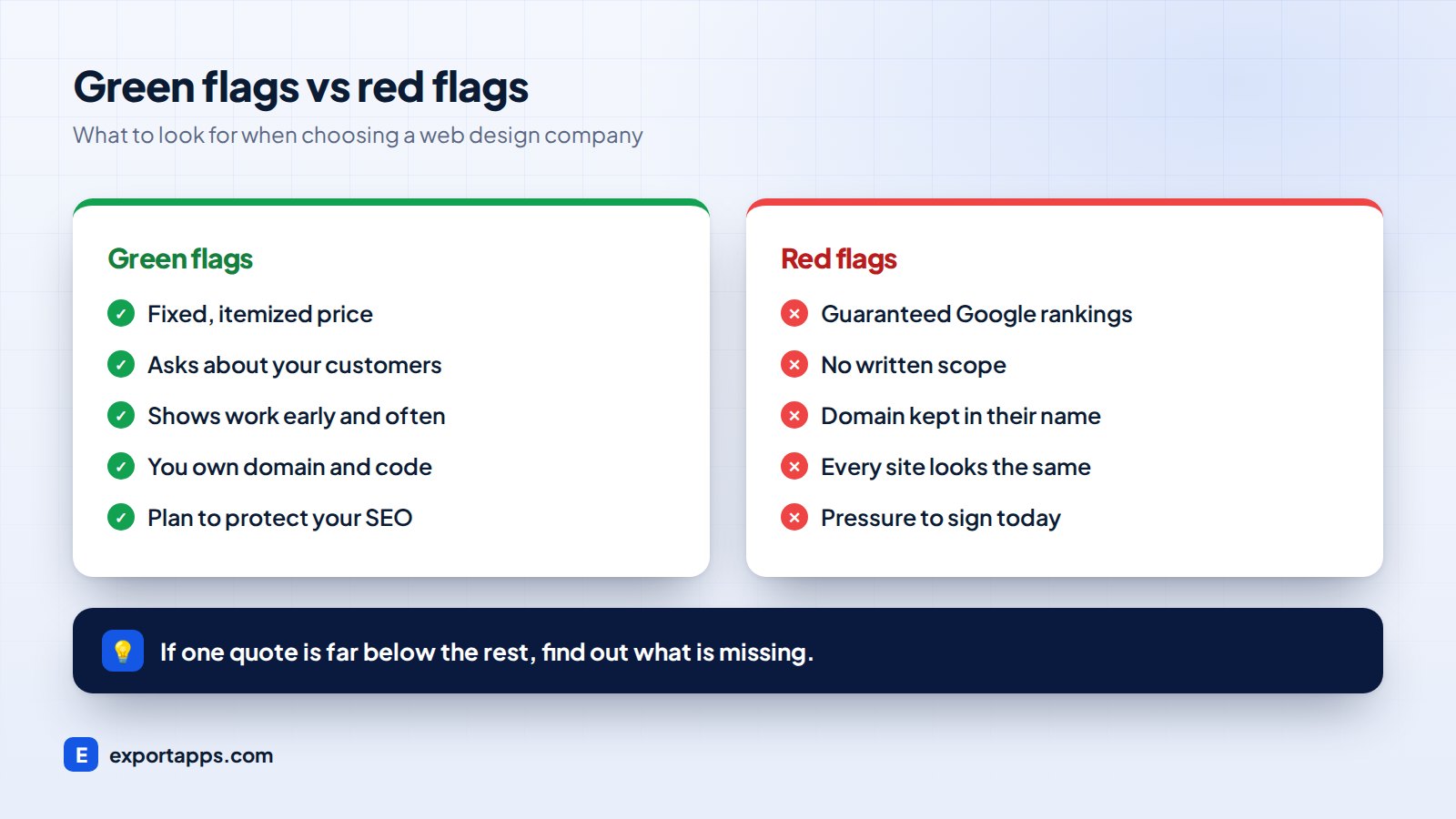
If one quote is far below the others, find out what is missing. It is usually content, SEO, testing or support. If you are thinking about a team in another country, our guide to outsourcing software development explains how to compare cost, time zones and communication.
Red flags to watch for
- Guaranteed rankings. No honest company can promise a number one position on Google. Good teams build strong foundations and explain how long SEO usually takes.
- No written scope. If it is not written down, it is not included.
- They keep your domain or hosting in their name. You should always own these.
- Every portfolio site looks the same. You may get a recycled template with your logo on it.
- No questions about your business. They are selling a product, not solving your problem.
- Pressure to sign today with a "special discount".
Green flags that signal a strong partner
- They explain their process clearly and show you examples of each stage.
- They give a fixed price with an itemized scope.
- They talk about your customers and goals before talking about colors.
- They are honest about what they do not do and recommend specialists when needed.
- They show working pages early, not only at the end.
- They include a plan to protect your SEO if you are replacing an existing site. Our website redesign checklist shows what that plan should include.
Freelancer, small studio or large agency?
Each option can work. The right one depends on your project.
- Freelancer: often the lowest price and great for a simple site, but one person covers everything and availability can be a risk.
- Small studio or software company: a team of designers, developers and SEO people with direct communication. Often a good balance for small and mid-sized businesses.
- Large agency: strong for big brands and complex campaigns, with higher prices and more layers between you and the people doing the work.
If your website will grow into a web platform with logins, bookings or custom features, choose a partner that also builds software. The same principles apply as when you choose a software development company.
Frequently asked questions
How many web design companies should I contact?
Three to five is usually enough. Fewer gives you no comparison and more takes a lot of time without adding much. Send each company the same short brief so their proposals are easy to compare.
Should I choose a local web design company?
A local company can be easier to meet in person and may know your market well, but it is not essential. Many businesses work happily with remote teams. What matters most is clear communication, overlapping working hours and a written process.
What should a web design contract include?
The scope, fixed price, payment milestones, timeline, number of revisions, ownership of domain, code and content, support terms and how changes are approved and priced.
Can a web design company guarantee Google rankings?
No. Nobody controls Google's results. A good company builds a fast, well-structured site with strong SEO foundations and explains what you can do to improve visibility over time.
Talk to a team that gives you a clear answer
Export Apps designs and builds websites and web platforms for businesses in the USA, UK, Canada and Europe. We ask the hard questions up front and give you a clear, fixed quote. See our web design services or book a free consultation to talk through your project.