A practical guide to outsourcing software development for US, UK, Canadian and European businesses: models, costs, risks and a step by step process.
You need software built, but hiring a full in-house team is slow and expensive. Recruiting developers can take months, and you may not need them full time once the product is live. That is why so many businesses turn to outsourcing software development. Done well, it gets you a skilled team fast. Done badly, it costs you time, money and a product you cannot maintain.
This guide is written for business owners in the USA, UK, Canada and Europe. It covers the main outsourcing models, how costs compare, the real risks, and a step by step process for picking and managing a partner.
What does outsourcing software development mean?
Outsourcing means a company outside your business designs, builds, tests or maintains software for you. That can be a whole product, one part of it, or extra developers who join your existing team.
There are three common engagement models:
- Project-based: the partner delivers an agreed scope, often for a fixed price.
- Dedicated team: a team works for you full time, managed partly by you and partly by the partner.
- Staff augmentation: you add individual developers to your own team for a period.
Onshore, nearshore and offshore
Where your partner is based changes cost, communication and legal setup.
Onshore
A partner in your own country. Same time zone, same law, same business culture. Usually the highest hourly rates.
Nearshore
A partner in a nearby country with a similar time zone. For US and Canadian companies this is often Latin America or Canada itself. For UK and Western European companies it is often Central or Eastern Europe. Good overlap in working hours with moderate rates.
Offshore
A partner far away, often in Asia. Typically the lowest rates, but less working-hour overlap. Strong offshore teams handle this with clear processes and fixed meeting windows.

How costs compare
Hourly rates are only one part of the price. A typical outsourced project budget also covers design, project management, testing, deployment and support. When you compare partners, look at the total for the same scope, not the rate per hour.
As a broad pattern, onshore teams in the USA, UK, Canada and Western Europe charge the highest rates, nearshore teams sit in the middle, and offshore teams are usually lowest. But a lower rate can be cancelled out by extra hours, rework or slow communication. A senior team that gets it right the first time is often cheaper in the end.
Also plan for your own time. Someone in your business needs to answer questions, review demos and make decisions every week. Outsourcing removes the hiring burden, not the need for an engaged product owner.
Benefits of outsourcing
- Speed: a ready team can start in weeks, not months.
- Skills: access to designers, developers, testers and DevOps engineers you would not hire individually.
- Flexible cost: scale up for the build, scale down after launch.
- Focus: your team stays focused on customers and sales.
Risks, and how to reduce them
Outsourcing has real risks. Most can be managed with the right contract and process.
- Unclear scope. Fix it with a written specification or a paid discovery phase.
- Poor communication. Agree on a weekly demo, a shared project board and one named contact.
- Hidden quality problems. Ask about code reviews and testing, and get access to the repository from day one.
- Code ownership disputes. Your contract must transfer full ownership of code and designs to you.
- Data protection. If personal data of EU or UK residents is involved, you need a data processing agreement and, for transfers outside those regions, a valid transfer mechanism. Our guide to privacy-compliant software explains the basics.
- Vendor lock-in. Ask for documentation, standard technologies and a clear handover plan.
How to outsource software development: step by step
This is the process we recommend to every client, whether they work with us or not.
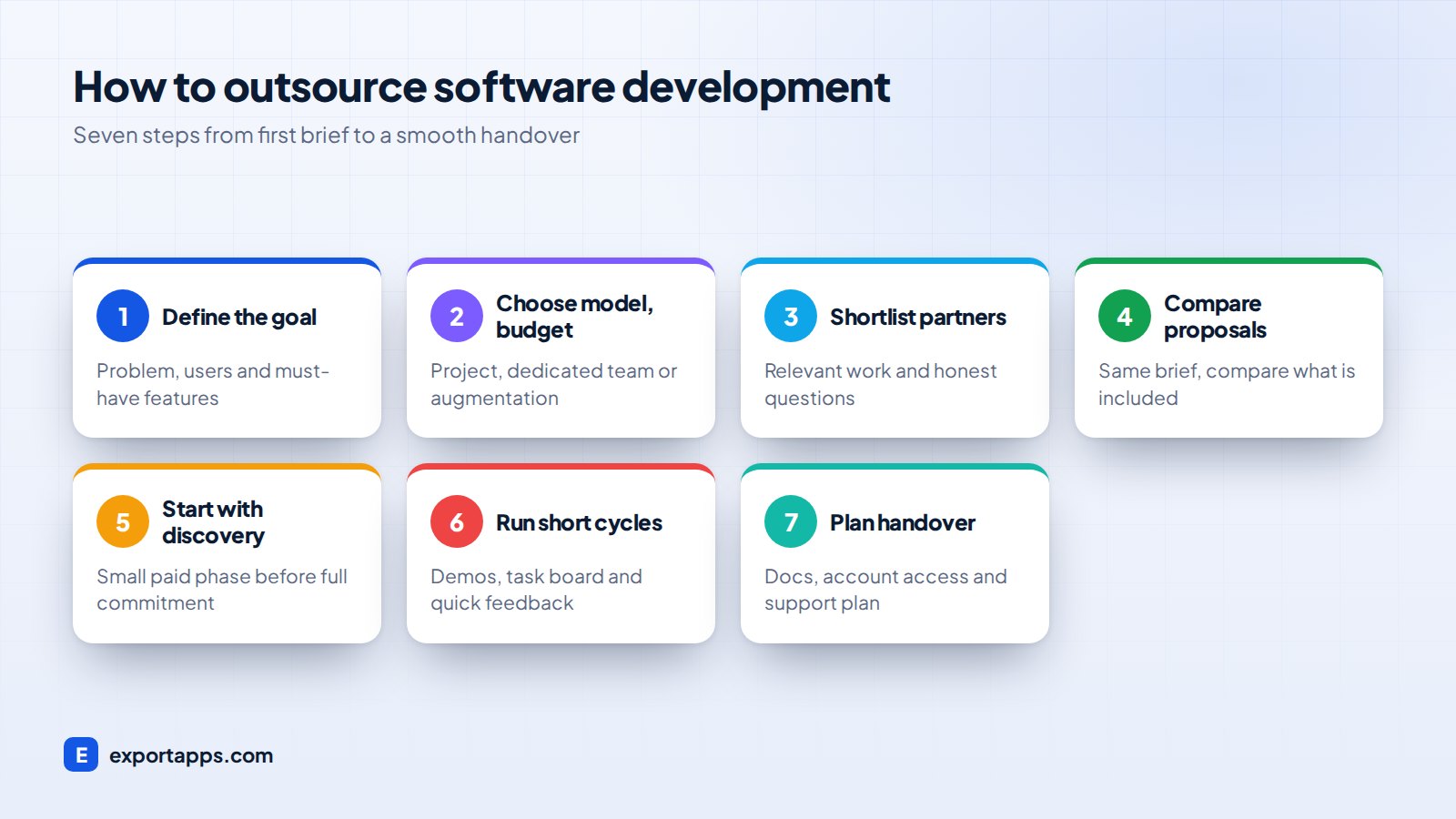
1. Define the goal and the must-haves
Write one page: the problem, who the users are, what success looks like and the features you cannot launch without. If it is a new product, read our MVP development guide to keep version one small.
2. Decide your model and budget
Choose project-based, dedicated team or staff augmentation. Set a realistic budget range. Our guide on custom software development cost gives typical ranges, and for apps see how much it costs to build a mobile app.
3. Shortlist three to five partners
Look for relevant past work, clear communication and honest questions about your project. Use our checklist on how to choose a software development company.
4. Compare proposals against the same scope
Send each company the same brief. Compare what is included: design, testing, project management, deployment and support. The lowest number often leaves things out.
5. Start with a discovery phase or small pilot
A short paid discovery, or a small first milestone, shows you how the team works before you commit the full budget.
6. Run the project in short cycles
Expect a demo every one or two weeks, a visible task board and short written updates. Give feedback quickly. Delays on your side slow the whole team.
7. Plan handover and support
Before launch, agree on documentation, access to all accounts and a support plan. You should be able to switch partners in future without starting over.
What to put in your contract
- Full IP and code ownership transferred to you on payment
- Repository and hosting access in your name
- A clear scope, milestones and acceptance criteria
- A change request process with written estimates
- Confidentiality terms or a separate NDA
- A data processing agreement where personal data is involved
- Warranty and support terms after launch
This is general information, so have a lawyer review contracts for your situation.
Working across time zones and borders
Good partners make distance feel small. Agree on a fixed daily or weekly overlap window for calls, and keep decisions in writing on the project board so nobody waits for the next meeting. Invoices in your currency (USD, GBP, EUR or CAD) and a contract under a law you understand also reduce friction.
Common mistakes to avoid
- Choosing on hourly rate alone
- Skipping discovery to save a few weeks
- Having no single decision-maker on your side
- Waiting until the end to see the product
- Forgetting the costs of hosting, maintenance and updates
If you are hiring for a mobile project, our guide on how to hire app developers adds app-specific checks.
Frequently asked questions
Is outsourcing software development cheaper than hiring in-house?
Often, for a defined project. You avoid recruitment, salaries, benefits and idle time after launch. For long-running core products, a mix of in-house leads and an outsourced team can work well.
Which is better, nearshore or offshore?
It depends on your needs. Nearshore gives better time-zone overlap. Offshore can lower rates. A strong process matters more than location.
How do I protect my idea when outsourcing?
Sign an NDA before sharing details, make sure the contract transfers IP to you, and keep the code repository and hosting accounts in your company's name.
What if the outsourced team does poor work?
Short cycles and regular demos let you spot problems early. Having repository access and documentation means you can move to another team if needed.
Work with a team that is easy to work with
Export Apps works with businesses across the USA, UK, Canada and Europe. We agree on scope in writing, demo progress every sprint and give you a clear fixed quote. Explore our services and custom software development, or book a free consultation.