An MVP lets you test your idea with real users before spending your full budget. Here is how to plan, build and launch one the right way.
Most new products fail not because they were built badly, but because they solved a problem people did not care enough about. A minimum viable product (MVP) protects you from that risk. It is the simplest version of your product that real users can use, built to learn quickly what works.
What an MVP is, and what it is not
An MVP is:
- A working product that solves one core problem well
- Good enough that real customers will use it, and ideally pay for it
- A tool for learning what to build next
An MVP is not:
- A rough prototype full of bugs
- Every feature you have ever imagined
- The final version of your product
Step 1: Define the one problem
Write one sentence: "Our product helps [who] to [do what] so that [benefit]." If you cannot fill this in clearly, it is too early to start building.

Step 2: Choose the must-have features
List every feature you want, then sort them into three groups:
- Must have: without it, the product does not solve the core problem
- Should have: valuable, but users can manage without it at first
- Nice to have: can wait for version two
Your MVP contains the first group only. This step alone often cuts the budget in half.
Step 3: Design the main user journey
Map the path a user takes from signing up to getting value. Every screen that is not on that path is a candidate to remove.
Deciding between platforms? Our comparison of web apps and mobile apps helps you pick the right first step.
Step 4: Build with a stack that can grow
Speed matters, but so does the future. Choose proven technology that your team, or a future team, can extend without rewriting everything. Cross-platform mobile frameworks and modern web frameworks let you launch on several platforms quickly.
Step 5: Measure from day one
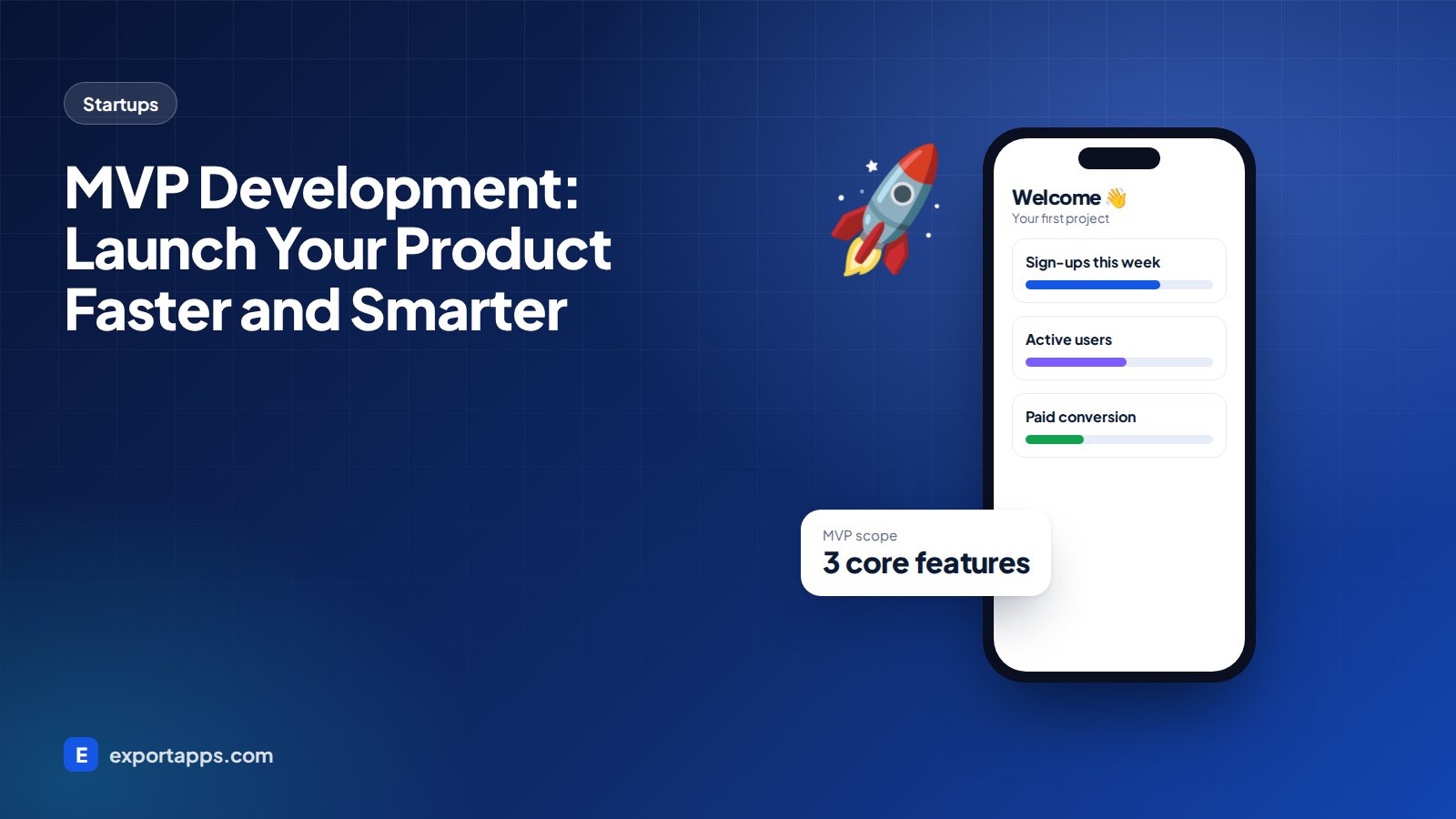
Decide what success looks like before launch: sign-ups, active users per week, conversion to paid, or retention after 30 days. Add analytics so you know exactly how people use the product.

Step 6: Launch, listen and improve
Talk to your first users. Watch where they get stuck. Release improvements every week or two. The fastest-learning teams usually win.
Common MVP mistakes
- Building too much. Every extra feature delays the moment you learn the truth.
- Skipping design. Users judge quality quickly. Simple is fine, confusing is not.
- No plan for feedback. An MVP without measurement is just a small product.
- Choosing the cheapest builder. If the foundation is poor, you will pay to rebuild it once the product works.
For budget planning, see how much it costs to build a mobile app.
How long does an MVP take?
Many MVPs can be designed and built in roughly two to four months, depending on complexity. A focused scope is the biggest factor in launching quickly.
Ready to test your idea?
Export Apps helps founders and businesses turn ideas into launch-ready MVPs with a fixed scope and price. Share your idea with us and get a free consultation.