
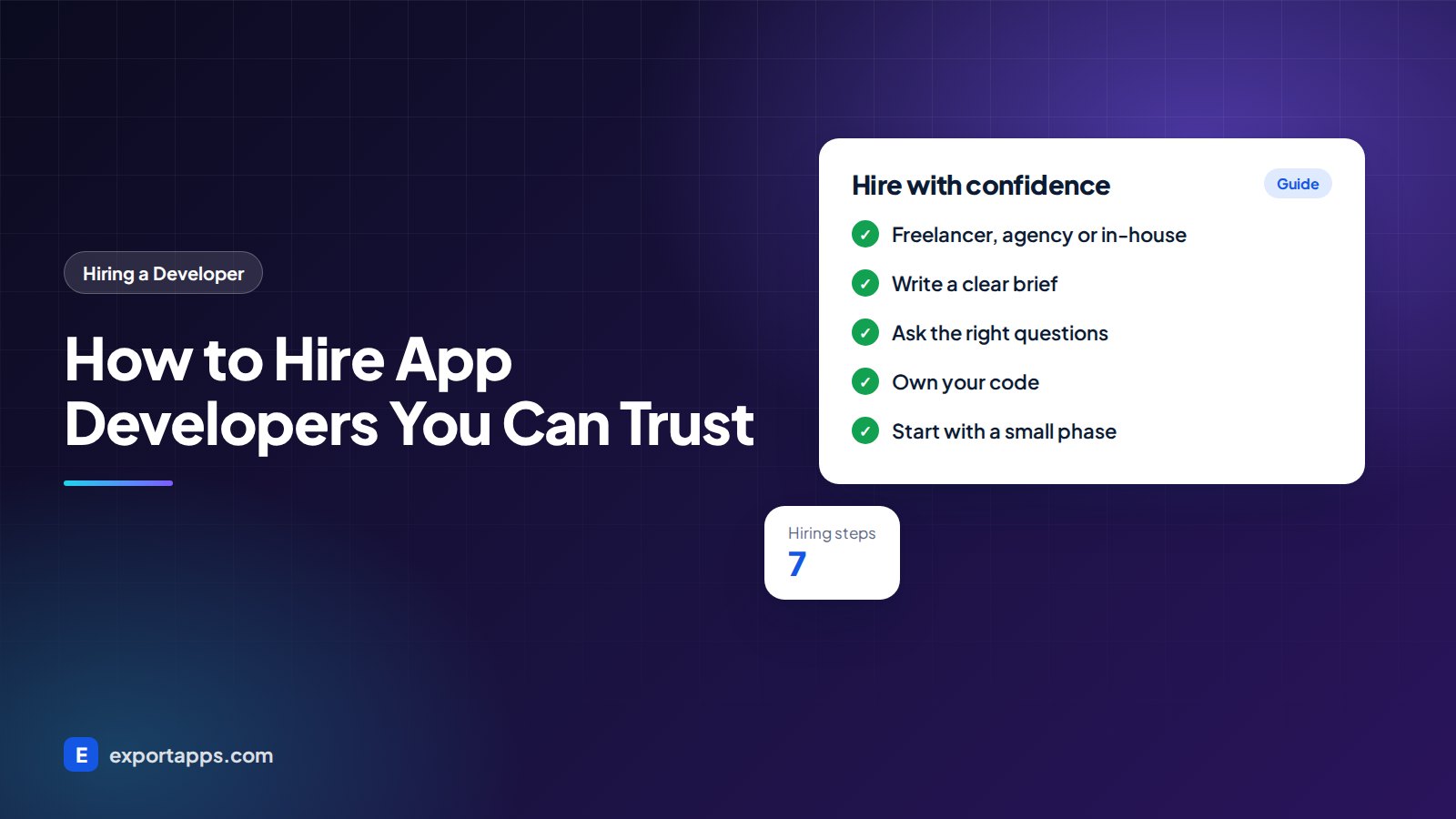
Freelancer, agency or in-house team? Learn how to hire app developers you can trust, what to ask and which red flags to avoid.
Your app idea is only as good as the people who build it. Many founders discover this the hard way: missed deadlines, buggy releases or a developer who disappears halfway through. If you are wondering how to hire app developers you can actually trust, you are asking the right question before spending a single dollar.
This guide compares the three main hiring options, gives you a 7-step process to follow, and lists the questions and red flags that separate good teams from risky ones. It is written for business owners in the USA, UK, Canada and Europe who are not developers themselves.
Your three main options
Freelance developers
A freelancer is an independent developer you hire directly, usually through a marketplace or referral.
- Good for: small apps, prototypes, fixes and short projects
- Watch out for: one person covering design, frontend, backend, testing and app store work. If they get sick or busy, your project stops.
App development agencies
An agency gives you a full team: project manager, designers, developers and testers.
- Good for: complete apps from idea to launch, with one point of contact
- Watch out for: agencies that sell with senior people and then hand work to juniors. Ask who will actually build your app.
In-house developers
You hire employees who work only on your product.
- Good for: companies with a long-term product and budget for a permanent team
- Watch out for: time to hire, salaries, benefits and the need for several roles, not just one developer
Many businesses combine these. For example, an agency builds version one while you hire an in-house lead to take over later. Our guide to outsourcing software development covers this in more detail.

How to hire app developers: a 7-step process

1. Write a one-page brief
Describe the problem your app solves, who will use it, the five to ten must-have features, your target platforms, budget range and ideal launch date. You do not need technical detail. A clear brief gets you better quotes and makes comparison easier.
If you have not decided on platforms yet, read iOS vs Android first before you start.
2. Decide your hiring model
Use the comparison above. For a first version with a fixed budget, an agency or an experienced freelance team is often the simplest choice. For a long-term product, plan for in-house roles later.
3. Build a shortlist of three to five candidates
Use referrals, review platforms and portfolios. Look for apps similar to yours in features or industry. Download their published apps and try them yourself.
4. Ask the right questions
Book a call with each candidate and ask:
- Have you built something similar? Can I see it in the store?
- Who exactly will work on my project?
- Which technologies do you recommend and why? (Listen for a reason, not just a favorite tool.)
- How do you estimate time and cost?
- How will I see progress, and how often?
- How do you test on real devices?
- What happens after launch?
Our article on how to choose a software development company has 12 more questions you can use.
5. Check technical skill
If you are not technical, ask a trusted developer friend or advisor to join one call. Ask candidates to explain a past technical decision in simple words. Good developers can explain why they chose Flutter, React Native or native code. Our Flutter vs React Native guide gives you background for that conversation.
6. Compare proposals fairly
Line up each proposal by scope, timeline, team, testing, support and ownership. A quote that is far lower than the rest usually means something is missing. For realistic numbers, see how much it costs to build a mobile app.
7. Start with a paid discovery or small first phase
Before committing to the full build, run a short paid discovery or first milestone. It shows you how the team communicates, plans and delivers. If it goes well, continue. If not, you have lost weeks, not months.
What to put in the contract
Your contract protects you. Make sure it covers:
- Code and IP ownership: you own the source code, designs and documentation once paid
- Repository access: access to the code from day one, not just at the end
- Accounts in your name: Apple, Google, cloud hosting and domains
- NDA: confidentiality for your idea and data
- Payment milestones: tied to working software, not dates alone
- Change process: how new requests are estimated and approved
- Support terms: response times and maintenance costs after launch
- Data protection: responsibilities under GDPR, UK GDPR, PIPEDA or CCPA where relevant. See our privacy-compliant software guide.
This is general guidance, not legal advice. Have a lawyer review important contracts.
Onboarding your new developers
The first two weeks set the tone for the whole project. Make them count:
- Share everything in one place. Your brief, brand assets, competitor examples and any existing designs or code.
- Give access early. Developer accounts, hosting, analytics and any systems the app must connect to.
- Introduce the decision maker. One person on your side who can answer questions and approve work quickly.
- Agree on communication. Which chat tool, how often you meet, and how urgent issues are raised.
- Set the first milestone. A small, visible result in the first sprint builds trust on both sides.
Clear onboarding also makes the app development process smoother, because the team spends less time waiting and more time building.
Typical rates to expect
Developer rates vary widely by region, experience and hiring model. As a rough guide, North American and Western European developers usually charge more than teams in Eastern Europe, Latin America or Asia. Agencies cost more per hour than freelancers but include project management, design and testing. Compare total project cost and risk, not hourly rates alone. Your project may differ.
Red flags to avoid
- They agree to everything without asking questions
- No written proposal, scope or timeline
- No published work you can try
- They want to keep the code or accounts until the final payment
- Very vague answers about testing and post-launch support
- Pressure to sign quickly with a "limited time" discount
Frequently asked questions
Should I hire a freelancer or an agency to build my app?
Freelancers suit small apps, prototypes and short projects. Agencies suit complete apps that need design, development, testing and launch support. If your app is your business, the added team and backup an agency provides often lowers risk.
How do I hire app developers if I am not technical?
Write a clear brief, ask candidates to explain decisions in plain words, try their published apps and bring in a trusted technical advisor for one call. Start with a small paid phase before committing to the full build.
Who should own the app code?
You should. Your contract should state that you own the source code, designs and documentation once you pay, and you should have repository access from the start.
How long does it take to hire app developers?
Hiring an agency or freelancer can take a few weeks including calls and proposals. Hiring in-house employees usually takes longer because of interviews, notice periods and onboarding.
Talk to a team you can trust
Export Apps builds iOS, Android and cross-platform apps with full code ownership, regular demos and clear fixed quotes. Learn about our mobile app development services and book a free consultation to discuss your idea.


