Flutter and React Native both build iOS and Android apps from one codebase. Here is how they differ and how to pick the right one for your business.
If you want an app on both iPhone and Android without paying for two separate builds, you will quickly meet the Flutter vs React Native debate. Both are mature, popular and used in real production apps. Both let one team ship to both stores from a single codebase. So which one should you choose?
This guide explains the differences in plain English, from a business owner's point of view. You do not need to know how to code. You need to know how each choice affects cost, speed, hiring and the long-term health of your app.
What are Flutter and React Native?
Flutter is an open-source framework created by Google. Apps are written in a language called Dart. Flutter draws every pixel of the interface itself, which gives designers a lot of control and makes the app look the same on every device.
React Native is an open-source framework created by Meta. Apps are written in JavaScript or TypeScript, the same languages used for most websites. React Native uses the phone's native interface components, so the app tends to feel close to a standard iOS or Android app.
Both are "cross-platform": most of the code is shared between iOS and Android. If you are still deciding which platform to launch first, read our guide on iOS vs Android first.
Why cross-platform is popular
For most business apps (booking, delivery, field service, marketplaces, customer portals), a cross-platform framework gives you:
- One codebase for two platforms, which usually lowers cost
- One team instead of two
- Features released on iOS and Android at the same time
- Easier maintenance after launch
Fully native apps (Swift for iOS, Kotlin for Android) still make sense for some products, such as apps that rely heavily on the latest device features or advanced graphics. For typical budgets, see our guide on how much it costs to build a mobile app.

Flutter vs React Native: the key differences
Language and team skills
React Native uses JavaScript or TypeScript. If your company already has web developers who use React, they can share knowledge and sometimes code with the mobile app. Flutter uses Dart, which is easy to learn but less common outside Flutter itself.
User interface and design
Flutter renders its own widgets, so custom, brand-heavy designs look identical on every device. React Native maps to native components, so it feels very "at home" on each platform. Both can produce beautiful apps; the difference is how much custom design work your app needs.
Performance
For most business apps, users will not notice a performance difference between the two when they are built well. Both frameworks have invested heavily in performance in recent years: Flutter with its rendering engine, React Native with its newer architecture. Heavy animation, games or complex graphics may favor Flutter or native code, but that depends on the app.
Ecosystem and libraries
Both have large collections of open-source packages for payments, maps, push notifications, analytics and more. React Native benefits from the huge JavaScript ecosystem. Flutter's package library is well organized and growing. Before you choose, check that the specific services you need (for example a payment provider in your country) have good support.
Web and desktop
Flutter can also build web and desktop apps from the same code, which can be useful for internal tools. React Native focuses on mobile, but React on the web shares the same ideas, so web and mobile teams can work closely. If you are weighing a web product instead, see web app vs mobile app.
Hiring and long-term support
React Native developers are often easier to find because many JavaScript developers can move into it. Flutter developers are widely available too, and many teams like how consistent Flutter projects are. Both are backed by large technology companies and active communities. Our guide on how to hire app developers explains how to check skills in either framework.
When to choose Flutter
- Your app needs a highly custom, branded design
- You want the app to look identical on every device
- You may also want a web or desktop version of an internal tool
- Your team has no existing JavaScript investment
When to choose React Native
- Your team already uses React or JavaScript on the web
- You want a native look and feel on each platform
- You expect to share logic or developers between web and mobile
- You need many JavaScript libraries or integrations
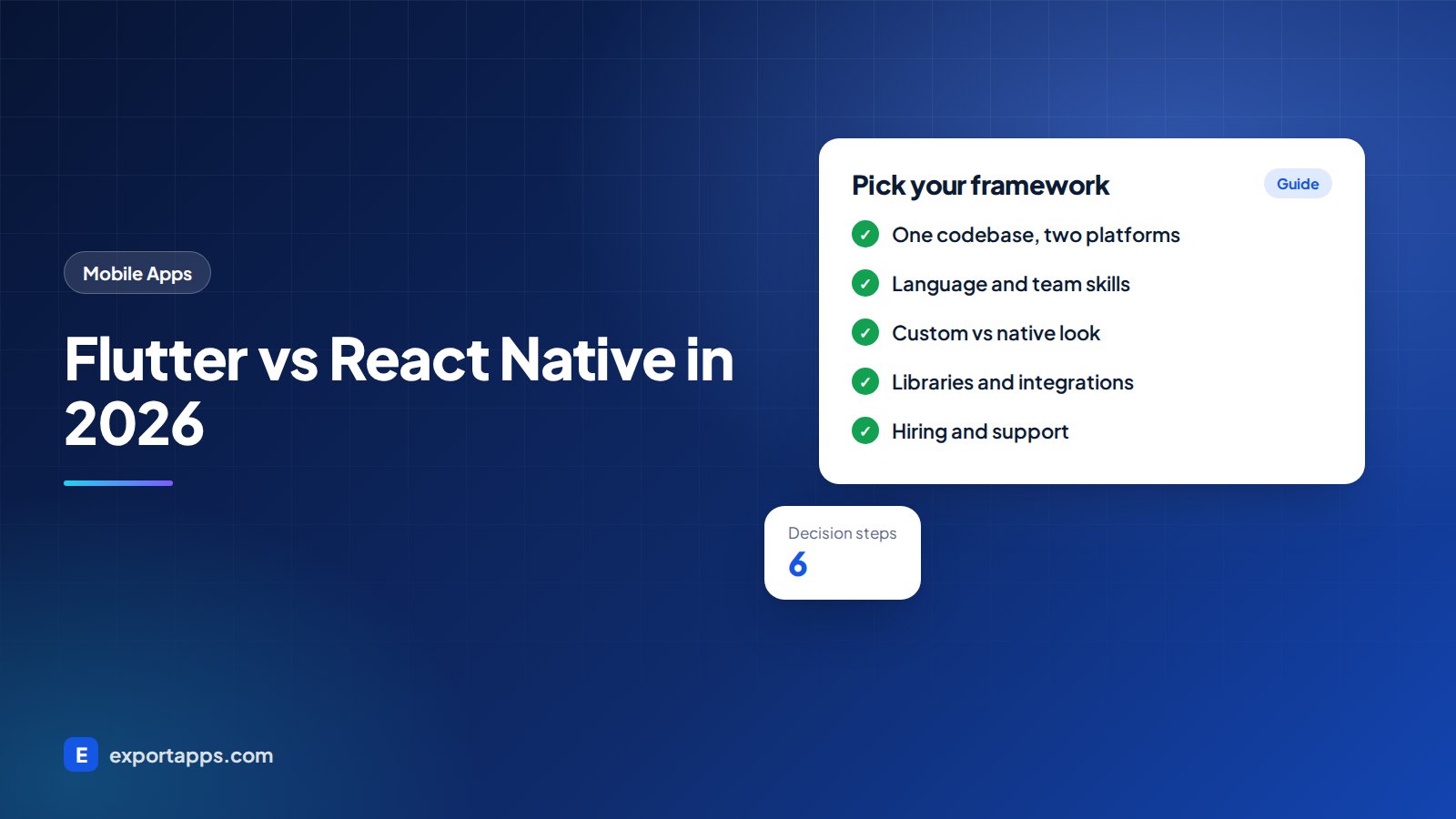
How to choose: a 6-step process

- List your must-have features. Note anything unusual: Bluetooth, background location, video, AR, offline mode.
- Check integrations. Confirm that your payment, mapping, login and analytics providers support your chosen framework well.
- Look at your current team. If you have React web developers, React Native has a head start. If not, both are equal.
- Decide on design style. Custom brand-led design leans to Flutter. Platform-native feel leans to React Native.
- Build a small prototype. A one or two week spike on the riskiest feature tells you more than any comparison article.
- Plan for maintenance. Choose the framework your team (or partner) can support for the next three to five years.
This decision usually happens in the planning stage of the app development process, before design work starts.
Questions to ask your developer
Whichever framework you lean toward, ask your development team these questions before you commit:
- Which framework have you shipped the most production apps with, and can I try them?
- What is the riskiest feature in my app for this framework, and how will you handle it?
- How will you handle device features such as the camera, location or notifications?
- How do you keep the framework and its packages up to date after launch?
- If we ever need native code for one feature, can your team write it?
Good answers are specific and honest about trade-offs. Be cautious of anyone who says one framework is perfect for every project. If you plan to move from spreadsheets or paper into an app for your team, our guide on moving your business from paper to online software is a helpful starting point.
Does the framework change the cost?
The framework itself is free. Cost comes from developer time. In many projects the price difference between Flutter and React Native is small compared to the effect of scope, design complexity and integrations. A clear, focused first version matters far more. Our MVP development guide shows how to keep scope under control.
Prices are commonly quoted in USD, but teams in the UK, Canada and Europe will price in GBP, CAD or EUR. Compare quotes by scope, not by headline number.
Frequently asked questions
Is Flutter better than React Native in 2026?
Neither is better for every app. Flutter is strong for custom designs and consistent visuals. React Native is strong for teams with JavaScript skills and apps that should feel native. Choose based on your team and features.
Which is cheaper, Flutter or React Native?
Usually the difference is small. Both share most code across iOS and Android. Your scope, design and integrations affect cost far more than the framework.
Can I switch from React Native to Flutter later?
You can, but it usually means rewriting the app interface. It is better to choose carefully at the start and keep your backend independent so it works with any frontend.
Do big companies use Flutter and React Native?
Yes. Both frameworks are used in production by large and small companies. Google maintains Flutter and Meta maintains React Native, and both have active open-source communities.
Get an honest recommendation
At Export Apps we build with both frameworks, so our advice is based on your app, not our habits. Explore our mobile app development services and book a free consultation. We will recommend the right framework and give you a clear, fixed quote.