Launching on iOS or Android first is a business decision, not a tech one. Here is a simple way to choose the right platform for your users and budget.
You have an app idea, a budget and a deadline. Then your developer asks the question that stops many founders: iOS vs Android first, which one do we build? Pick the wrong platform and you may launch to an audience that is not there, or spend money on a second app before the first one has proven anything.
The good news is that this is mostly a business decision, not a technical one. Once you know who your users are and how you plan to make money, the answer usually becomes clear. This guide walks you through the factors that matter and a simple process to decide.
Why the "first platform" question still matters
Many apps today are built with cross-platform tools such as Flutter or React Native, which let one codebase run on both iOS and Android. So why choose at all?
Because even with shared code, launching on two platforms at once means two app store reviews, two sets of devices to test, two store listings and two streams of user feedback. For a small team or a first version, that extra work can slow you down. Many founders choose to launch on one platform, learn fast, then add the second a few weeks or months later.
If you are still deciding whether you need an app at all, read our comparison of a web app vs mobile app first. Sometimes a web app is the faster, cheaper first step.
The key factors to compare
Where your users actually are
This is the most important factor. Platform share varies a lot by country, age group and income level. In general, iPhones have a strong position in the USA, Canada and the UK, while Android is more common across much of mainland Europe and most of the rest of the world. But "in general" is not good enough for your business.
Look at your own data: website analytics (device and operating system reports), your existing customer base, and what your competitors' apps show in each store. If you sell to business teams who are given company phones, ask what those phones are.
How you plan to make money
If your app relies on in-app purchases or subscriptions, many teams start with iOS because iPhone users in North America and Western Europe are often seen as more willing to pay for apps. Treat that as a common pattern, not a guarantee, and test it with your own audience.
If your app earns money another way (ads, a physical service, a B2B contract), the monetization argument for iOS gets weaker and reach may matter more.
Development and testing effort
Android runs on thousands of device models with different screen sizes and manufacturer changes. That means more testing. iOS runs on a smaller set of Apple devices, so testing is usually simpler. With a cross-platform framework, the gap narrows, but it does not disappear. Our Flutter vs React Native guide explains how these tools handle both platforms.
App store rules and costs
Apple charges a yearly developer fee and Google charges a one-time registration fee. Apple's review tends to be stricter and can take longer, especially for a first release. Google's review is usually faster, which makes Android handy for early testing. Both stores take a commission on digital sales, with reduced rates for smaller businesses under their programs. Check the current terms before you plan your pricing.
Your launch market and regulations
If you launch in the EU, the Digital Markets Act has changed some rules about app distribution and payments on iOS. If you handle personal data, privacy law applies on both platforms: GDPR in the EU, UK GDPR in the UK, PIPEDA in Canada and CCPA in California. Our guide to privacy-compliant software covers the basics.
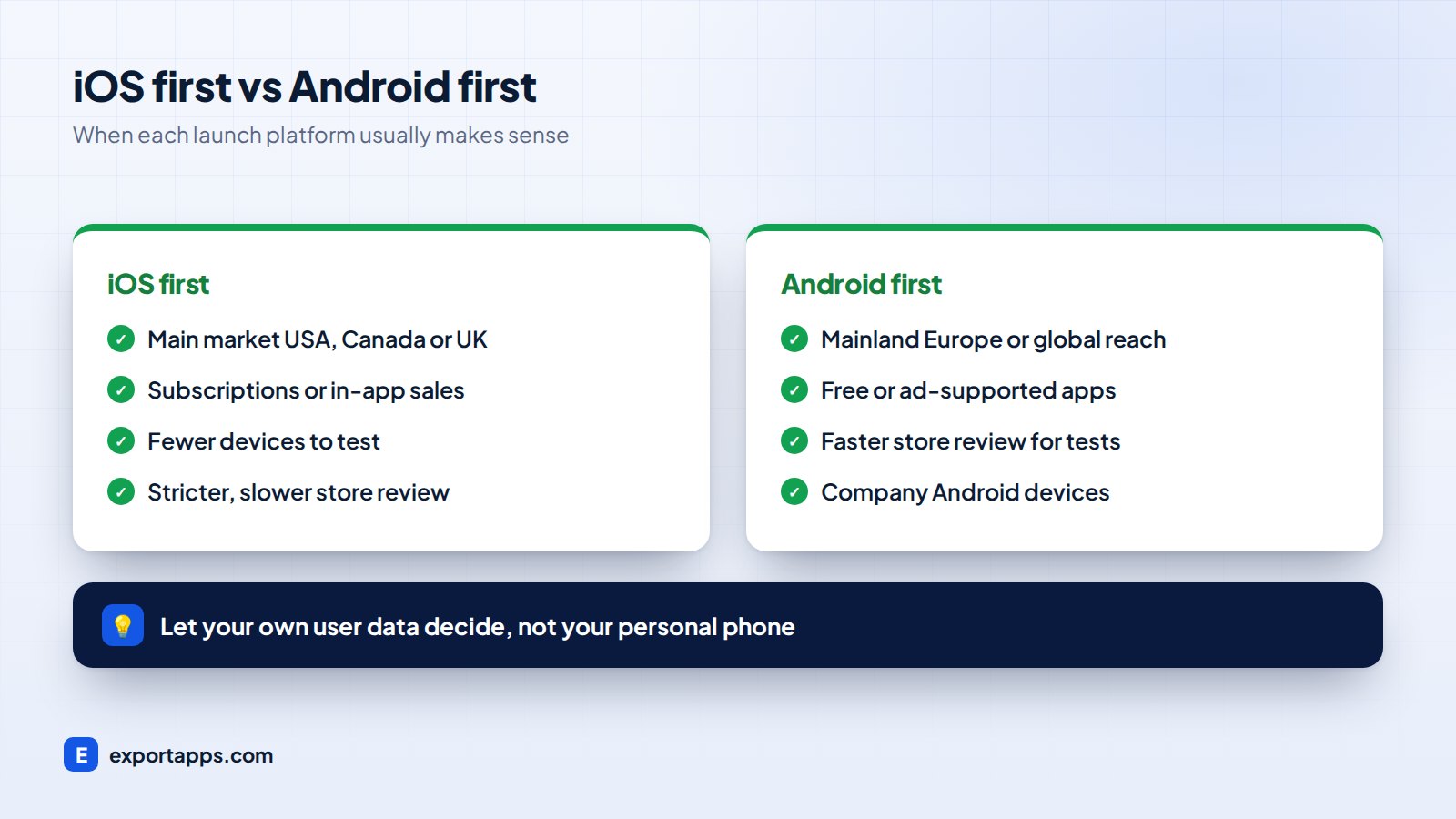
Quick comparison: iOS first vs Android first
iOS first often makes sense when:
- Your main market is the USA, Canada or the UK
- You plan to charge for subscriptions or in-app purchases
- You want a smaller set of devices to test
- Your target users are professionals or higher-income consumers
Android first often makes sense when:
- Your main market is mainland Europe or a global audience
- Your app is free or supported by ads
- You want faster store reviews for early testing
- Your users are field workers or teams using company Android devices
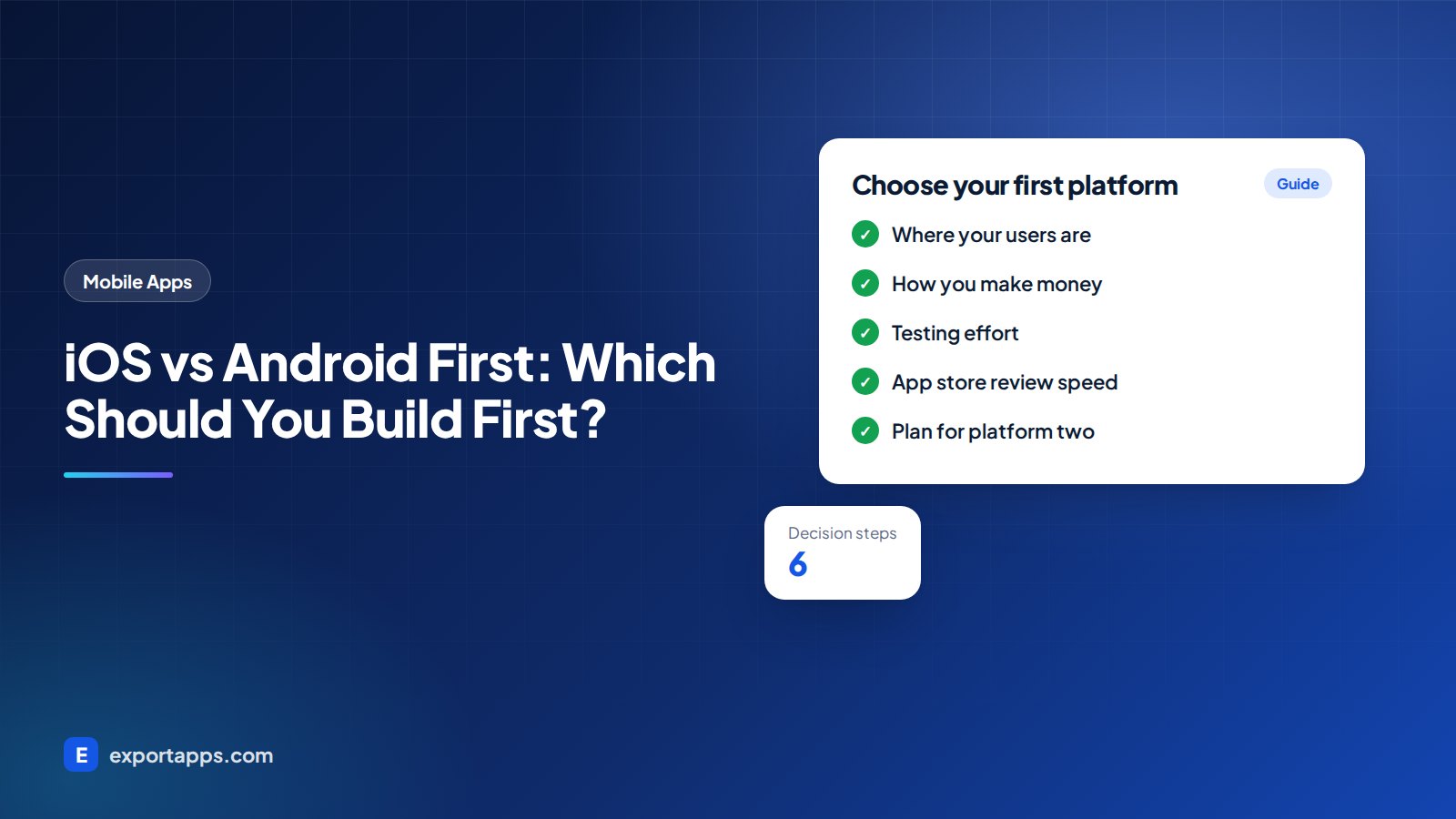
How to decide: a 6-step process

1. Define your first 1,000 users
Write down who they are, where they live and what phone they most likely carry. Be specific: "dental clinic receptionists in Ontario" is better than "small businesses".
2. Check real device data
Look at your website analytics, email list and customer records. If you have no data, check public market share reports for your country and review competitor apps in both stores.
3. Map your revenue model
Decide how the app makes money in year one. Subscriptions and in-app purchases lean toward iOS in many Western markets. Free, ad-based or service-led apps lean toward reach.
4. Choose your tech approach
Decide between native (Swift for iOS, Kotlin for Android) or cross-platform. If you go cross-platform, adding the second platform later is much cheaper. Our app development process guide shows where this decision fits.
5. Plan the second platform from day one
Even if you launch on one platform, design the backend, APIs and user accounts so the second app can plug in easily. This avoids a costly rebuild later.
6. Set a clear trigger for expansion
Agree on what will make you launch the second platform: a number of active users, a revenue target or a set number of weeks after launch. This keeps the decision based on evidence, not pressure.
What it costs to build for one or both platforms
Building on one platform first is usually cheaper up front. If you use a cross-platform framework, adding the second platform often costs a fraction of the first build, because most of the code is shared. With two native apps, you are close to building the app twice.
For typical price ranges in USD, GBP, EUR and CAD, see our guide to how much it costs to build a mobile app. If you want to keep your first version small, our MVP development guide shows how to cut scope without cutting quality.
Common mistakes to avoid
- Choosing based on your own phone. Your users matter more than your preference.
- Launching both platforms too early. Twice the work can mean half the learning speed.
- Ignoring the backend. A good backend makes the second platform quick to add.
- Forgetting store preparation. Screenshots, privacy labels and review notes take time on both stores.
- Hiring a team with only one skill set. If you plan both platforms, choose a team that can deliver both. Our guide on how to hire app developers explains what to check.
Frequently asked questions
Is it better to launch on iOS or Android first?
There is no single right answer. iOS first often suits subscription apps targeting the USA, Canada or the UK. Android first often suits free apps, global audiences and teams using company Android devices. Use your own user data to decide.
Can I launch on both iOS and Android at the same time?
Yes. With Flutter or React Native, one team can ship both apps from one codebase. It still adds testing and store work, so it suits teams with a clear scope and enough budget.
How much more does it cost to add the second platform later?
With a cross-platform framework, usually much less than the first build, since most code is reused. With two native apps, the second platform can cost close to the first. Your project may differ.
Does Apple or Google review apps faster?
Google Play reviews are usually quicker. Apple reviews can take longer and are often stricter, especially for a first submission. Plan a buffer of several days for either store.
Ready to choose your platform?
If you are unsure which platform fits your users, we can help you look at the data and plan a launch that leaves room to grow. Learn about our mobile app development services or book a free consultation and get a clear, fixed quote for your first version.